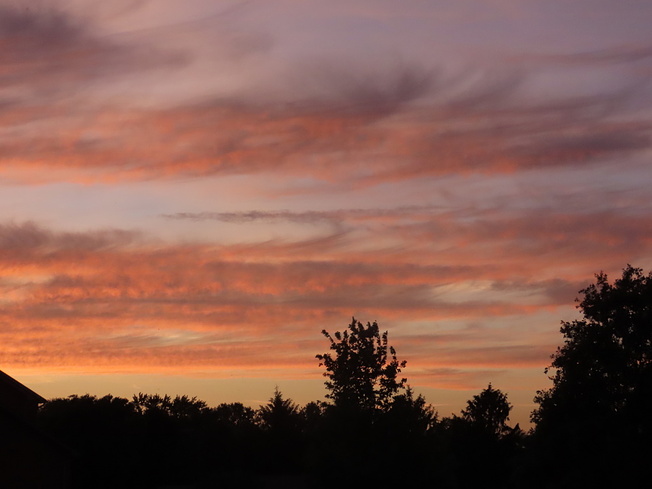
Down once again to one chicken—the indominable Black Chicken.
Happened on Icky's watch—I never let the chickens out unless I can sit outside watching out for them for a couple of hours. Not that that matters, I suppose—Nature red in tooth and claw, predators are gonna do what predators are gonna do. Without a chicken run, they were dead chickens walking.
But it feels better to have someone to blame, and I blame him.
I think it was some kind of raptor.
Icky had let the chickens out and then taken off.
When it was near dark, I went down to shut them in their coop—only they weren't in their coop.
So, I took off calling for them: "Chickens! Chickens!"
And eventually found Black Chicken, sitting dazed by the compost heap, with a big (thankfully superficial) wound on her back. I'm thinking the only way she could have gotten
that is if some large raptor bird had swooped down on her & tried to carry her off.
Somehow, she managed to get away! Black Chicken is a survivor.
The other black chicken wasn't as lucky.
The other black chicken had just begun trusting me enough to take bits of tasty tortilla treats out of my hand. I was almost comfortable enough with her longevity prospects—
almost—to make up a silly nickname for her. She was a very cautious chicken.
Icky
did take Black Chicken to a vet—the wound will heal, she'll recover.
But she
won't be
fine without a companion: Chickens are very social little creatures.
I wish I could just kidnap Black Chicken and smuggle her to
![[profile]](https://www.dreamwidth.org/img/silk/identity/user.png) egg_shell
egg_shell! The Underground Chicken Railroad!
egg_shell knows how to take care of chickens!
But she's not my chicken.
I am sad, though I accept the inevitability. This is what life is. Since animals can't photosynthesize, eventually all of us are on the cafeteria menu. In the end, we all get eaten, whether that be by lions and tigers and bears or bacteria.
###
The garden is driving me a bit nuts because the
weeds are growing so fast, particularly those fuckin' nettles. The weeds are thriving! My vegetables, not so much.
It's a very different environment than the Hyde Park Community Garden. For one thing, it's in full sunlight. Since we are now in full summer—not by the calendar but meteorologically—I've been watering the garden every other day, but possibly I'm overwatering it? The cucumber leaves have yellow spots, the basil pinkish spots.
Traditionally, I've always found weeding by hand meditative. But not this much weeding! So today, I'm gonna go over to the Home Depot to see if I can pick up a cheap, portable weed wacker.
###
Finished Chapter 7. It was difficult to write: I really wanted a different authorial voice than I used in Part 1. I
think I succeeded in that. But Flavia is just not as interesting a character as Grazia was. Plus I am now in the realm of pure fictioneering, since Flavia is not a Patrizia interject. Whole cloth fictioneering carries a special set of challenges that involve plotting as well as style.
###
My knee is still a problem. Some days it improves; some days, it's Not Good. It's
not the patella—it's some ligament behind the patella. Although it
affects the patella because if that ligament is hurting, I use the leg in a particular way that puts weird stress on the patella.
It was bad yesterday,
very achey, so after I watered the garden, I just lay on my fainting couch icing it all day and
reading (Chaim Potok's
The Promise, which is a treasure trove of useful Hasid information should I ever go back to my June Miller novel.)
It feels 100% better today, so maybe that's what I need to do for a couple of days.
NothingBut I always feel so guilty when I do
nothing.
![[community profile]](https://www.dreamwidth.org/img/silk/identity/community.png) followfriday
followfriday